Discussion Topics

Time Travel

Faster than Light Travel

Alien Life

Artificial Intelligence & Consciousness

Cloning & Genetic Engineering
 Terraforming
 Energy Weapons
 Force fields & shields
 Nanotechnology
Force fields & shields Digital Immortality
 Parallel Universes
Faster than light FTL
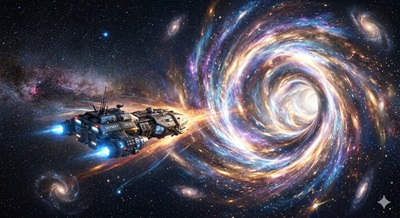
Could it be possible to travel faster than the speed of light? In theory yes, but it's a far more complex issue than it first appears. We know from Einstein that space is like a fabric (called space-time) and that the fabric can be bent or twisted. If we had a technology that would compress space-time at the front of our spaceship and at the same time expand it at the rear of our spaceship then we would have a hyperdrive system. Sounds easy eh? The only way of compressing the fabric of space is to use a large amount of mass (like a star or a black hole). A definite challenge, and one beyond us for the foreseeable future. However, that doesn't mean it's impossible.
Wormholes have always captured the imagination in science fiction, to be able to move from one place to another instantly, where that place could be a great distance away. Famous science fiction with wormholes include Stargate, Star Trek, Dr Who and if you go back quite a few years "The Time Tunnel".
Scientific theory states that there could be millions of wormholes being created and destroyed at a quantum level all the time. The great challenge is to: (1) create one at a quantum scale which goes where you want it to go and (2) grow it big enough so that you can safely travel through it without being ripped to bits. Both of these tasks are currently impossible with current technology, although if we could make a quantum scale wormhole we do know how to make it get bigger, just simply use anti-gravity. Unfortunately science has never seen anti-gravity although it has not disproved it either. To create anti-gravity you would need nagative energy and current technology hasn't developed negative energy, nor even knows whether it exists!
The bottom line is that it's not absolutely impossible in theory, but our current knowledge of science isn't anywhere near sufficient to determine what the science says, let alone thinking about the technologu. This will be the case for a very long time. The exciting aspect is that it could be possible!